

The following XML instance files are in the USM schema:
The usm-query file defines meta-data specifying type elements that you can use in a query. For performance queries, the CA Catalyst infrastructure assumes you can query some elements, but not all (some properties cannot be queried to select particular instances returned). Elements you can query are specified as QueriableElements in the usm-correl-query file.
The usm-openenums.xml file defines the values for enumerations that are expected to evolve over time and are hierarchical. These types of enumerations are difficult to define as opposed to static enumerations, which are not expected to change. Static enumerations are defined within an XSD, using the xs:restriction of a string and the xs:enumeration facet. However, taking this approach means that any change to the enumeration is a revision of the schema. Schema revisions that update one enumeration value are not desirable.
Using xs:enumeration works well when defining closed sets of values such as the days of the week. It does not work well when defining value lists for country, vendor, or operating system names, which change over time, sometimes daily.
Static (closed) enumerations are an exception. Most enumerations are open (evolving). Enumerations can constantly grow, be subject to interpretation or perspective, or can be hierarchical. Another example of an open enumeration is a US region value list that specifies a country by quadrants, versus a different customer’s perspective that defines smaller groupings of selected states. USM can define enumerations in an XML instance file where a property’s value can be checked against the instances in the usm-openenums file. An error or warning (depending on the needs of the application) can report when a new value is encountered and alert needs to spell-check, correct the value, or add to the enumeration meta-data.
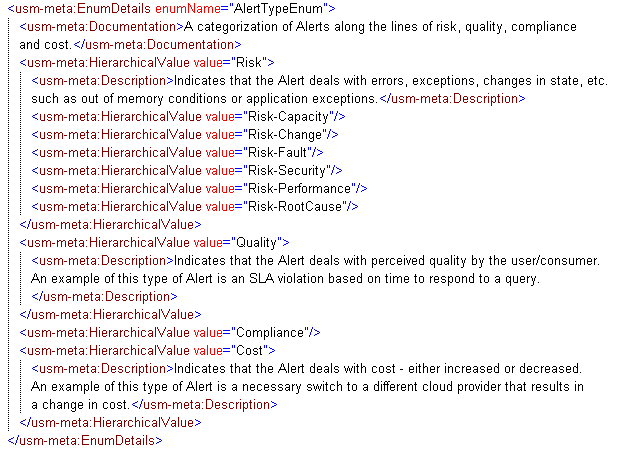
The following illustration shows an example of an open enumeration from the usm-openenums.xml file for the AlertTypeEnum:
The CA Catalyst infrastructure and CA Technologies products require specific data. The USM schema is not directly tagged with this data as it is stored in a separate XML instance file called usm-infraadefaults.xml (infrastructure defaults).
|
Copyright © 2013 CA.
All rights reserved.
|
|